






Manual Lathes vs. CNC Lathes: 10 Key Buying Factors for Machine Shops
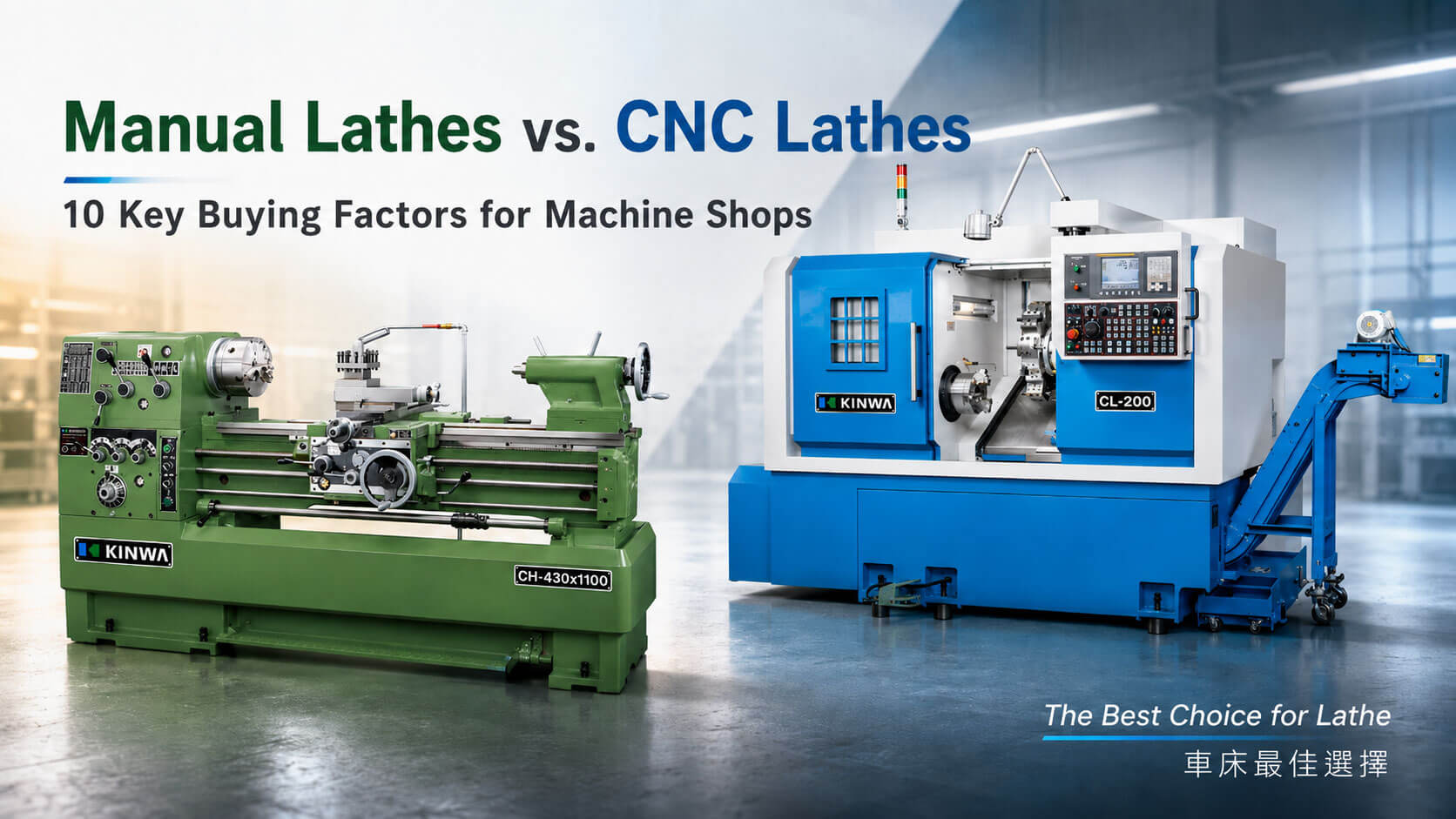
When establishing a new machine shop or expanding an existing production line, manufacturers often face a key decision: whether to choose manual (conventional) lathes or CNC lathes. Manual lathes are often preferred for repair work, shaft machining, prototyping, and high-mix, low-volume production, while CNC lathes are typically a better fit for repeatable precision parts and medium- to high-volume output.
To make the right choice, machine shops often compare 10 key buying factors, including production quantity, tolerance requirements, workforce allocation, setup frequency, investment cost, maintenance considerations, and long-term production flexibility. For many operations, a hybrid setup can offer the most practical balance between flexibility and output.
I. Ten Core Evaluation Factors: Manual Lathes vs. CNC Lathes
1. Equipment Cost and Depreciation
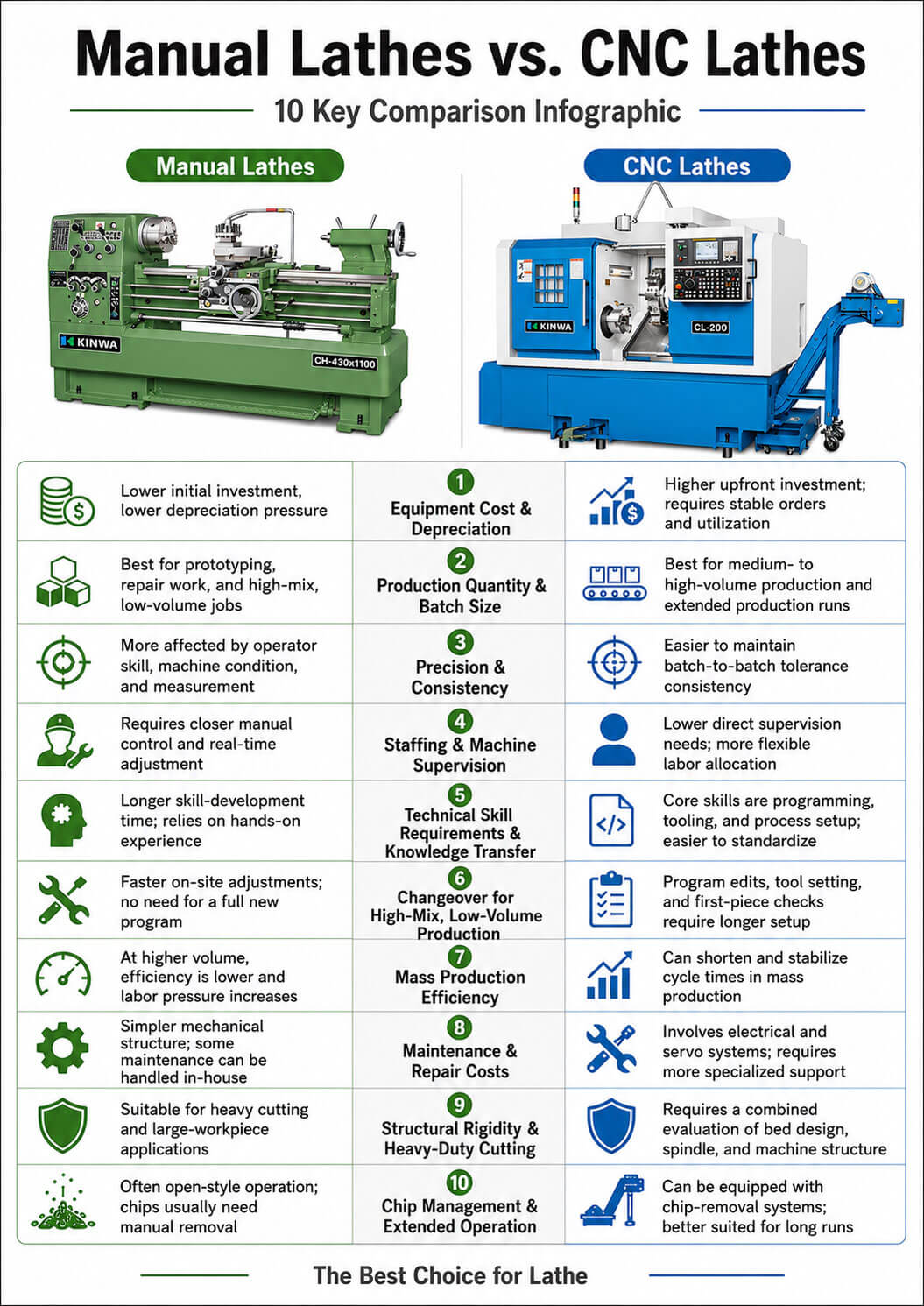
Manual lathes generally require a lower initial investment and involve lower depreciation costs, making the payback period easier to manage. CNC lathes require a higher upfront investment and typically provide better economic returns when supported by stable order volumes and suitable utilization rates.
2. Production Quantity and Batch Size
Manual lathes are generally better suited for single-piece prototyping, occasional repair work, and high-mix, low-volume production. Once programming, tooling, and process setup are completed, CNC lathes are more suitable for medium- to high-volume production and extended production runs.
3. Precision and Consistency
The machining quality of manual lathes depends not only on operator experience, but also on machine condition, tooling, workholding, and measurement methods. CNC lathes use numerical control and servo systems, making it easier to maintain consistent tolerances across production batches.
4. Staffing and Machine Supervision
Manual lathe operation generally requires closer manual control and real-time adjustment by the operator. Once a CNC program is running reliably, the machine requires less direct supervision, allowing greater flexibility in workforce allocation and production scheduling.
5. Technical Skill Requirements and Knowledge Transfer
Developing manual lathe skills often requires a longer training period, and some machine shops face growing pressure to develop skilled personnel and transfer practical experience. CNC expertise is concentrated in programming, tooling, and process setup, while shop-floor operating procedures can often be standardized and transferred more readily.
6. Changeover for High-Mix, Low-Volume Production
When specifications change frequently, manual lathes do not require the development of an entirely new program and can be adjusted quickly on the shop floor. CNC lathes may require program loading or modification, tool setting, and first-piece inspection, resulting in longer setup times.
7. Mass Production Efficiency
In mass production, CNC lathes can use automatic tool turrets and optimized machining paths to shorten and stabilize cycle times. When workpiece specifications are fixed and order volumes are sufficient, CNC lathes generally provide a clear production output advantage.
8. Maintenance and Repair Costs
Manual lathes are primarily based on mechanical structures, so their maintenance requirements are relatively straightforward, and some routine servicing can be performed by in-house personnel. CNC lathes incorporate electrical control, servo systems, and position-feedback systems, so maintenance generally requires more comprehensive OEM or specialist technical support.
9. Structural Rigidity and Heavy-Duty Cutting
KINWA manual lathes, including the CH and CHD Series, feature high-rigidity bed designs suitable for heavy-duty cutting and large-workpiece applications. CNC lathes should be evaluated based on bed configuration, spindle specifications, and overall machine structure to achieve an appropriate balance between machining speed and cutting rigidity.
10. Chip Management and Extended Operation
Manual lathes commonly use an open machine configuration and usually require manual chip removal. Depending on the model and optional equipment, KINWA slant-bed CNC lathes in the CL Series can be equipped with automatic chip conveyors. The bed angle and chip-removal system help improve chip evacuation efficiency and support extended machining operations.
II. Machine Shop Purchasing Decision Matrix
| Evaluation Scenario / Criteria | Manual Lathe — KINWA CH / CHD / CHK Series | CNC Lathe — KINWA CL Series |
| Core Business and Application Profile | Single-piece prototyping, fixture and die manufacturing, long shafts, large workpieces, repair work, and heavy rough machining | High-volume production of standard parts and precision components |
| Precision Control Requirements | Relies on measuring tools and manual fine adjustment; capable of meeting different tolerance requirements depending on machine condition and operator skill | Provides higher batch consistency; optional cooling and tool-setting devices can improve stability during extended machining |
| Workforce and Technical Skills | Suitable for shops with experienced machinists capable of independent manual operation | Requires programming and machine setup personnel; multi-machine supervision can be evaluated based on cycle time, automatic loading, and inspection requirements |
| Budget and Return on Investment | Suitable for limited budgets or variable utilization rates, with emphasis on lower initial investment and ownership costs | Suitable for stable order forecasts, with emphasis on long-term capacity and cost-per-part efficiency under high utilization |
III. Industry Trend: The Hybrid Setup Strategy
Modern precision machine shops no longer treat manual and CNC lathes as a strict either-or decision. Instead, many facilities adopt a hybrid setup to combine the strengths of both machine types.
1. Roughing and Finishing Process Separation
KINWA manual lathes, including the CH and CHD Series, can be used for high-stock-removal rough machining and shaft prototyping. Depending on workpiece tolerances, production volume, and process requirements, the workpiece can then be transferred to a KINWA CL Series CNC lathe for finish machining.
This type of process separation may reduce the heavy roughing load placed on CNC machines. However, overall efficiency should still be evaluated based on material handling, repeated clamping, total processing time, and precision requirements.
2. Process Optimization and Production Flexibility
Manual lathes are suitable for quick fixture adjustments, urgent repair work, and very small prototype batches. This helps prevent frequent interruptions to CNC machines assigned to high-volume production.
Combining both machine types maintains production flexibility while preserving the capacity required for batch orders.
IV. Equipment Selection Checklist and Practical Guidelines
To support a more data-driven purchasing decision, production managers should evaluate the following practical factors.
Workpiece Dimensions and Weight
For long shafts or large and heavy workpieces, evaluate high-rigidity manual lathes or flat-bed CNC lathes based on swing over bed, distance between centers, load capacity, and workholding conditions.
For small- to medium-sized precision components, slant-bed or gang-type CNC lathes may be evaluated according to workpiece geometry, production volume, and tooling configuration.
Spindle Bore Size
Confirm the diameter of the bar stock and select a suitable spindle bore size. This helps avoid situations in which the workpiece cannot pass through the spindle and must be cut into shorter sections before machining.
Surface Finish and Constant Surface Speed
For workpieces with significant diameter changes and strict surface finish requirements, CNC lathes equipped with Constant Surface Speed (CSS) can adjust spindle speed according to the cutting radius.
This helps maintain more consistent cutting speed and surface quality.
Material Hardness
When machining hard or difficult-to-cut materials, evaluate machine rigidity, spindle torque, tooling, workholding, and cutting parameters together.
High-rigidity manual lathes and heavy-duty CNC machine structures can both help reduce chatter and improve cutting stability, depending on the actual machining conditions.
KINWA Precision Machinery: Your Professional Lathe Planning Partner
With more than half a century of precision lathe manufacturing experience, KINWA provides machine selection and after-sales support based on workpiece size, production volume, precision requirements, and automation needs.
Whether the application requires high-rigidity manual lathes from the CH, CHD, and CHK Series, or high-precision CNC lathes from the CL Series, KINWA supports machine shops worldwide with appropriate equipment selection, production planning, and technical support.
The Best Choice for Lathe