






Buying a Lathe? Look Beyond the Price: How to Evaluate 10-Year TCO
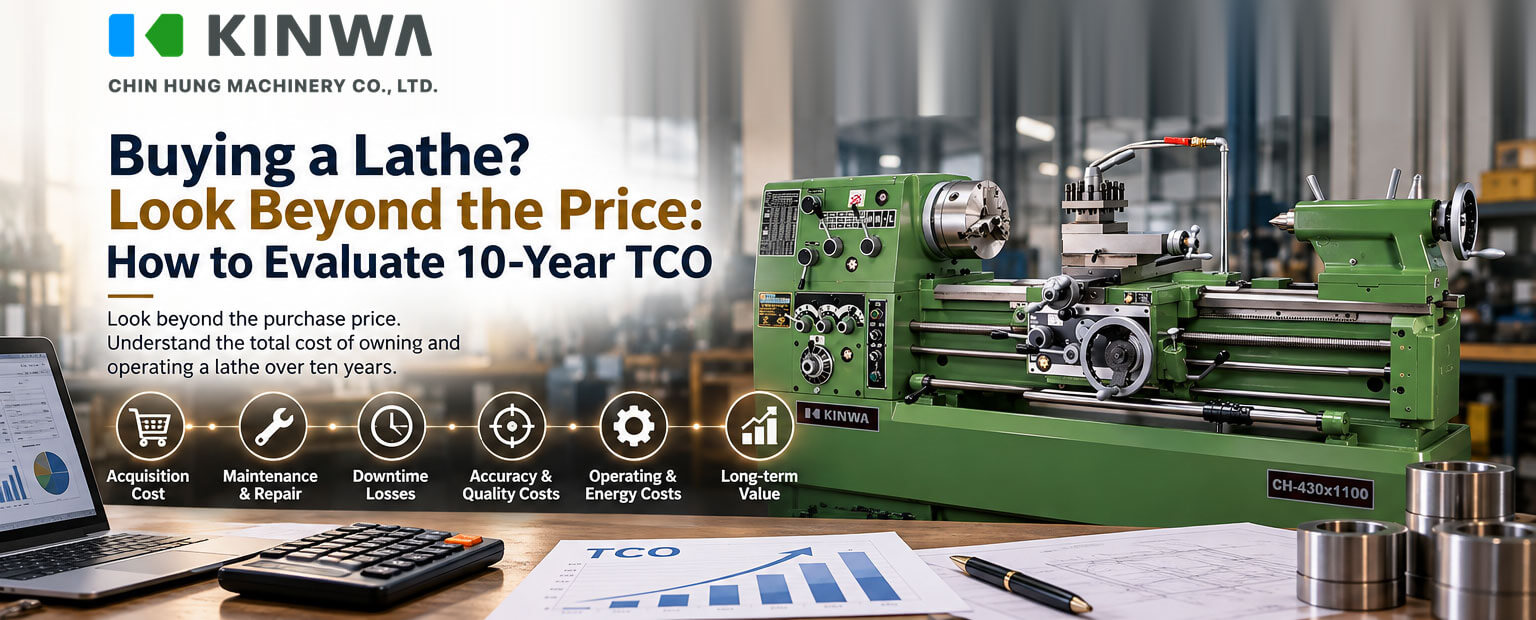
Is comparing only the purchase price of a lathe really the most cost-effective approach? Does a lower-priced machine necessarily result in a lower total cost over ten years?
In metalworking, the machine price is often the first figure discussed when a new machine is being considered. However, once a lathe enters production, the factors that shape its long-term cost extend beyond the initial purchase price to maintenance, downtime, accuracy retention, parts availability, and service life.
For machining operations that run equipment for extended periods, machine stability and utilization can affect production scheduling and, in turn, delivery performance. As equipment ages, increasing maintenance frequency, difficulty maintaining accuracy, or delays in obtaining replacement parts can gradually narrow the initial price gap.
That is why, when purchasing a lathe, it is worth asking not only “How much does it cost?” but also “What is the total cost of owning and operating this machine over its service life?” This is the core concept behind TCO (Total Cost of Ownership).
What Is Lathe TCO (Total Cost of Ownership)?
TCO is a method for evaluating the total cost of equipment across its entire operating life. It considers not only the initial equipment investment, but also potential costs after the machine enters production, including maintenance, repairs, downtime, accuracy retention, operation, energy consumption, and the machine’s long-term value.
The 10-year TCO of a lathe can be understood as:
TCO = Acquisition Cost + Installation / Configuration Cost + Energy & Operating Costs + Maintenance & Repair Costs + Downtime Losses + Potential Quality / Scrap Costs − Residual Value
Actual TCO varies according to machine specifications, machining requirements, production volume, labor costs, and operating conditions. A single figure therefore should not be applied universally to every machining operation.
What Are the Hidden Costs of a Lathe?
Equipment costs are like an iceberg: the purchase price is only the visible portion. The costs that are easier to overlook are the accumulated operating, maintenance, and hidden costs after the machine enters production.
- Visible costs: The machine itself, transportation, installation, and initial configuration.
- Maintenance and parts costs: Consumables, scheduled maintenance, unplanned repairs, and parts availability.
- Downtime costs: Production interruptions, delivery delays, idle labor, schedule adjustments, and overtime required to recover production.
- Accuracy and quality costs: Accuracy deterioration can lead to machining defects, material waste, and customer complaints.
- Operating and energy costs: Operator efficiency, workload during extended operation, and energy consumption.
- Long-term value: Service life, residual / resale value, and future equipment replacement requirements.
How to Compare 10-Year TCO: Using Downtime Costs as an Example
If you look only at the purchase price, it is easy to overlook the cumulative costs that arise after a machine enters production. In practice, two machines can be evaluated under the same operating assumptions and compared across the major cost categories over ten years.
| Cost Item | Lathe A | Lathe B |
|---|---|---|
| Initial acquisition | Lower | Higher |
| 10-year maintenance / repair | Estimate based on equipment and operating conditions | Estimate based on equipment and operating conditions |
| 10-year downtime cost | Estimate based on downtime and daily production value | Estimate based on downtime and daily production value |
| Parts / consumables | Estimate based on availability and usage frequency | Estimate based on availability and usage frequency |
| Quality / scrap | Estimate based on actual machining quality | Estimate based on actual machining quality |
| 10-year residual value | Depends on market conditions and equipment condition | Depends on market conditions and equipment condition |
| 10-year TCO | Sum all costs and deduct residual value | Sum all costs and deduct residual value |
Using downtime as an example, the basic TCO estimation can be illustrated as follows:
Assume the machine contributes an estimated NT$20,000 in production value per day and an unexpected shutdown lasts three days. The basic loss in production value can be estimated as:
NT$20,000 × 3 days = NT$60,000
Additional costs can then be added according to actual conditions, including idle labor, expedited parts, repair expenses, overtime, and delivery delays. The actual amount should be estimated based on the products, labor hours, capacity, and operating conditions of the facility.
The key is not to assume in advance that one machine will always cost less. Instead, compare the complete 10-year cost under the same assumptions. A lower purchase price does not by itself indicate poor machine quality; likewise, a higher purchase price does not necessarily mean a lower TCO.
The example above illustrates the calculation logic only. Actual figures should be estimated according to machine specifications, production conditions, and the way the equipment is used.
What Factors Can Increase a Lathe’s Long-Term Cost?
1. Maintenance Cost Goes Beyond the Repair Bill
When a machine issue occurs, the cost may include not only repair charges, but also technician labor, replacement parts, machine setup and readjustment, and production schedule changes. If similar problems recur, the accumulated cost may gradually narrow or even offset the initial purchase-price difference.
2. What Does Lathe Downtime Cost Beyond Lost Production Value?
In addition to the basic loss calculated from estimated daily machine value and downtime days, actual downtime can affect personnel waiting time, schedule reorganization, overtime recovery work, outsourcing, delivery risk, and even subsequent processes. Downtime evaluation should therefore include not only repair expenses but also the additional handling and management costs it creates.
3. Parts Availability and After-Sales Service
The service life of a precision lathe may exceed ten years, making future maintenance requirements an important consideration at the time of purchase. The longer equipment remains in service, the more important parts availability and maintenance support generally become. Are commonly used parts readily available? Is appropriate service support available when a machine issue occurs? If parts or technical assistance require a long wait, downtime may increase accordingly.
4. Ease of Operation Is Also a Long-Term Cost Factor
Conventional lathes rely heavily on operator input. Smooth handwheel and feed operation, intuitive controls, stable machine response during machining, and operator fatigue during extended use can all affect actual productivity. These factors may not appear directly on a quotation, but their effects can accumulate in daily production.
Why Does Machine Structure Affect TCO?
TCO is not only a financial concept. It is also related to machine structure, manufacturing quality, and maintenance conditions. From a purchasing perspective, the relationship can be viewed as:
Machine structure & manufacturing process → Long-term stability → Accuracy & machining performance → Maintenance, downtime & quality costs
1. Casting Rigidity and Stress Relief → Accuracy Retention
The structural design, rigidity, and stress-relief treatment of the bed and major castings can affect long-term machine stability and accuracy retention. Purchasing decisions should therefore consider not only appearance and initial price, but also casting quality and process control.
2. Gear and Bearing Quality → Operating Stability
Gears and bearings inside the headstock are critical components of lathe operation. Selecting appropriate configurations according to the machine model and design requirements, together with controlled machining and assembly quality, helps maintain headstock operating stability and may reduce long-term maintenance risks.
3. Long-Term Component Supply → Reduced Waiting Risk
When equipment remains in service for many years, difficulty obtaining critical components can extend downtime. Before purchasing, confirm the supplier’s ability to provide commonly used and critical parts, as well as original-manufacturer support and service channels, to reduce the risk of extended downtime caused by parts availability issues.
Lathe Purchasing Checklist: What Should You Evaluate?
| Evaluation Area | What to Confirm Before Purchase |
|---|---|
| Machine stability & accuracy retention | Can the machine maintain stable machining performance and accuracy over long-term use? |
| Machine Utilization | Can the machine maintain stable operation and reduce the impact of unexpected downtime on production scheduling? |
| Ease of Maintenance | Are routine maintenance and repairs straightforward? When a machine issue occurs, can it be identified and addressed efficiently? |
| Parts supply & after-sales service | Will commonly used and critical parts remain available after years of operation? |
| Ease of operation | Are handwheel and feed controls smooth? Is extended operation manageable? |
| Service life | Is the machine structure and manufacturing quality suitable for long-term use and able to reduce the possibility of premature replacement? |
KINWA Practical Perspective
KINWA manufactures its own lathes and provides dedicated after-sales service and parts support. When helping customers evaluate high-speed precision lathe requirements, KINWA considers not only machine price and basic specifications, but also workpiece dimensions, material, machining requirements, production volume, and accuracy requirements. Different machining conditions call for different machine specifications, operating methods, and long-term usage considerations. From a practical machine-selection perspective, clarifying the machining process and production conditions first, then evaluating machine structure, parts availability, ease of maintenance, and future operating requirements provides a more complete basis for purchasing than simply comparing machine prices.
Price Is Only the Starting Point; Long-Term Cost Is the Key to Lathe Purchasing
Every machining operation has different product types, production volumes, and production requirements, so there is no single standard answer for equipment purchasing. Whether machining transmission shafts, plumbing hardware, precision hand tools, or other metal components, it is advisable to evaluate machine stability, accuracy retention, ease of maintenance, parts availability, operating efficiency, and service life together.
Buying a lathe is not simply about comparing how much you have to pay today. It also means considering what costs may arise over the machine’s service life and whether the equipment can continue to support production requirements. A TCO perspective provides a more complete basis for comparing long-term equipment costs.
If you are evaluating a high-speed precision lathe, provide your workpiece dimensions, material, machining requirements, production volume, and accuracy requirements. KINWA can assist in evaluating suitable lathe specifications and long-term operating conditions.
KINWA – Your Professional Lathe Planning Partner
The Best Choice for Lathe